Abstract
This paper examines the historical and structural evolution of Southern Chinese martial arts during the 19th and early 20th centuries. It traces the migration of the ancestral Fujian San Chien (三戰) blueprint across two distinct geopolitical pathways: the anti-Qing Cantonese Red Boat Opera insurgency (yielding Wing Chun) and the Ryukyuan-Fuzhou martial exchange (yielding Pangai-noon and Naha-te). By analyzing pedagogical adaptations, environmental constraints, and nomenclature conventions, this study isolates the raw engineering shifts that transformed rural village defense systems into highly specialized tools for urban espionage, military law enforcement, and modern Okinawan Karate.
I. Introduction and Theoretical Framework
Traditional Chinese martial arts of the Pearl River and Min River deltas are frequently obscured by romanticized oral folklore. When stripped of mythological narratives, the development of these systems reveals a logical process of military and civilian engineering.
The primary engine of Southern Chinese boxing (Nanquan) is rooted in the biomechanical principles of Yongchun White Crane Kung Fu (永春白鶴拳) and regional Southern Shaolin variants. This foundational blueprint prioritizes:
- Generation of short-range kinetic energy (Fa Jin).
- Stabilization of the spine and centerline.
- Utilization of physical contact vectors (“bridges”) to manipulate an opponent’s skeletal alignment.
This paper analyzes how this shared genetic blueprint mutated into distinct systems based on distinct operational environments and tactical requirements.
II. The Red Boat Modification: The Genesis of Wing Chun
The conventional lineage of Wing Chun attributes its creation to a Buddhist monastic nun. However, corroborated historical data identifies the Cantonese Red Boat Opera Company (Hung Suen) as the active operational cell that codified the art during the mid-19th century.
A. Environmental Constraints of the Red Junks
The tactical requirements of the Red Boat rebels—such as Wong Wah-bo and Leung Yee-tai—demanded a complete reconstruction of ancestral White Crane mechanics. The physical structure of the Hung Suen river vessels and confined rural environments imposed strict operational constraints:
- Rocking Platforms: Asymmetrical, forward-stepping stances native to rural Fujian boxing left fighters unstable on wet, moving wooden decks.
- Confined Spaces: Cramped cabins and narrow streets rendered wide animal-mimicking frames, sweeping circular deflections, and high-extension kicks completely non-functional.
- Clandestine Parameters: Operating under strict Qing imperial surveillance, the rebels required a system optimized for stealth, silent deployment, and immediate lethality.
B. Structural Adaptation from San Chien to Siu Lin Tau
The rebels took the core principles of the ancestral Fujian foundational form, San Chien (Three Battles), and compressed them into a single, massive, monolithic empty-hand routine historically recorded as Siu Lin Tau (小練頭—”Little Training Head”). This transition altered the system’s core physics:
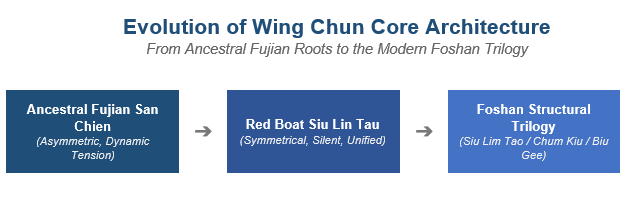
- The Stance Change: The asymmetric, forward-weighted step of San Chien was abandoned. The rebels squared the hips 50/50 and turned the toes inward, creating Yee Jee Kim Yeung Ma (Goat-Clamping Stance). This compression acted as a low-center-of-gravity shock absorber against the roll and pitch of the vessels, granting a defensive radius without requiring steps.
- The Eradication of Kinetic Hissing: San Chien relies on deep, forced diaphragmatic exhalations (Ibuki) to pack the internal organs and project power. Because a loud exhalation would alert imperial guards in an urban or shipboard ambush, the rebels substituted this with relaxed, silent nasal breathing. Power was generated entirely through short-range skeletal leverage rather than thoracic compression.
- The Centerline Vertical Punch: Open-hand crane deflections and spear-fingers were adapted or replaced by the vertical fist punch (Rih Chuan). Driven straight down the centerline from an anchored elbow, this strike required zero wind-up space, minimized the arm’s visual profile in low-light environments, and transferred total body mass directly into the target’s skeletal axis.
C. The Foshan Pedagogical Separation
The empty-hand forms practiced on the Red Junks were not originally divided into separate tiers. The single, continuous Siu Lin Tau long form was taught alongside one 108-movement flush-mounted Wooden Dummy (Mook Yan Jong) set and one weapons form: the Six-and-a-Half Point Long Pole (Luk Dim Boon Kwun), which was adapted directly from the heavy punting poles used to navigate shallow Cantonese waterways.
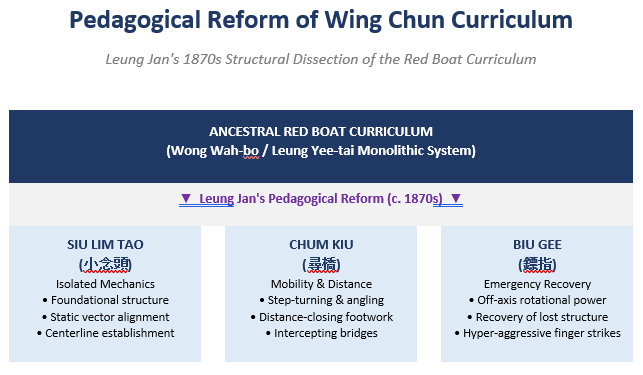
The monolithic long form was broken apart during the 1870s by Dr. Leung Jan (1826–1901) at his Jan Sang Tong pharmacy in Foshan. To create a logical, progressive training method for civilian students, Leung Jan dissected the long form based on functional mechanics:
- Siu Lim Tao (小念頭 – “Little Idea”): Isolated foundational architecture, vectors, and alignment performed from a completely stationary base.
- Chum Kiu (尋橋 – “Seeking the Bridge”): Integrated mobility templates, pivoting (Jun Ma), and distance-closing footwork to intercept a mobile opponent.
- Biu Gee (鏢指 – “Darting Fingers”): Consolidated emergency recovery tactics, off-axis striking templates, and short-range rotational power used when the centerline structure breaks down.
The dual short swords (Baat Cham Dao—八斬刀) entered the core system later. While Hudiedao (butterfly knives) were widely utilized across the Pearl River Delta by militias and pirates, they were integrated into the mainline Wing Chun curriculum as an extension of empty-hand mechanics during the late 19th and early 20th centuries, eventually codified through Leung Bik and Yip Man in Hong Kong.
III. The Okinawan Transmission: Pangai-noon vs. Naha-te
While the Red Boat rebels compressed the Fujian blueprint for guerrilla warfare, Two different Nanquan ecosystems migrated to Okinawa via two entirely different pathways, resulting in Pangai-noon and Naha-te.
A. The Pangai-noon Lineage (Uechi-ryu)
Pangai-noon (半硬軟—”Half-Hard, Half-Soft”) represents a direct, unmodified preservation of late-19th-century Fujian animal boxing. It bypassed the urban Okinawan expatriate enclaves in China entirely.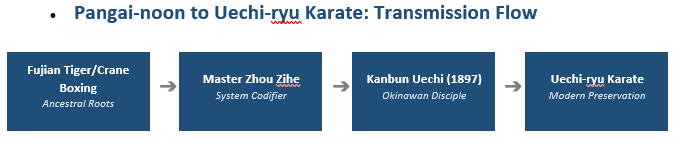
- Transmission: Kanbun Uechi fled to Fuzhou in 1897 to evade Japanese military conscription, training for over a decade under master Zhou Zihe (1874–1926)—a distinct Fujianese herbalist completely separate from Guangdong’s Leung Jan.
- Mechanics: Pangai-noon maintained the open-hand spear-fingers (Nukite), sharp hissed nasal breathing, 180-degree pivoting turns, and toe-striking front kicks (Shomen-geri) native to the regional Tiger and White Crane styles. It remained insulated from Okinawan modernization until Kanbun Uechi broke his vow of secrecy in Wakayama, Japan, during the late 1920s.
B. The Naha-te Lineage (Kojo Dojo Network)
Conversely, Naha-te represents an earlier migration wave that passed directly through the Ryukyu-kan (the Okinawan diplomatic settlement) in Fuzhou.
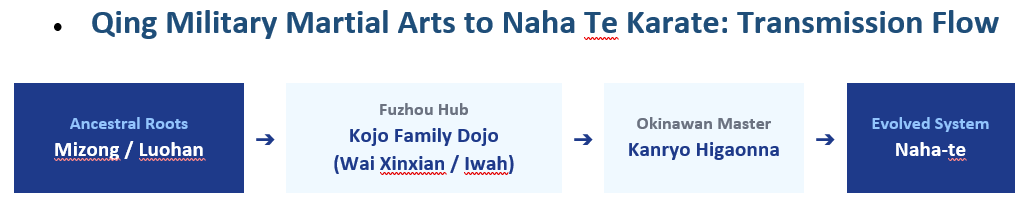
- Transmission: Master Kanryo Higaonna traveled to Fuzhou in the 1870s. Higaonna’s training was managed by the Okinawan expatriate community at the Kojo Family Dojo. There, he trained under Chinese military official Iwah and master Wai Xinxian.
- Mechanics: This environment synthesized elements of Mizongquan (Lost Track Boxing), Luohanquan (Monk Fist). It adapted the forms to suit the physical frames and defensive requirements of the Okinawan guard class for naval port security and law enforcement, creating a foundation that heavily influenced the development of Goju-ryu.
IV. Comparative Analysis of Independent Regional Trajectories
To understand the radical structural choices made during the development of Wing Chun and Pangai-noon, it is useful to map them against the concurrent, yet completely unrelated, modernization of Okinawan Naha-te. A persistent error in popular martial arts history is the assumption that because Naha-te, Pangai-noon, and historical Chinese boxing share common numerical names (Sanchin/3 battles, Seisan/13, Sanseiryu/36), they represent the same original routines.
Factual lineage tracking dismantles this. When Kanryo Higaonna trained within the restricted Okinawan expatriate network at the Kojo Dojo in Fuzhou, the system was built on a foundation of heavy, Shaolin military Boxing (Luohanquan and Mizongquan). It shared no lineage, no master, and no mechanical continuity with the fluid, open-handed San Chien framework developed by Zhou Zihe (Pangai-noon) or weaponized by the Red Junk rebels (Wing Chun).
By analyzing these arts as entirely separate systems that merely shared a cultural vocabulary, we can see how three distinct environments forced completely different physical choices:
1. The Manipulation of Foundational Frameworks
The mechanical architecture of an art’s core form reveals its ultimate tactical environment:
- The Pangai-noon Path: Kept the ancestral, rural Fujian template intact. Its Sanchin preserved an asymmetric, forward-stepping footprint, using open spear-hands (Nukite) designed for raw, tissue-tearing, penetrative striking in open-ground combat.
- The Wing Chun Path: Faced with the wet, rocking wooden decks of Cantonese opera riverboats, the Red Junk rebels executed a radical structural compression. They pulled the asymmetric footwork back into a perfectly squared, symmetrical 50/50 horse stance (Yee Jee Kim Yeung Ma), creating a low center of gravity that functioned as a shock absorber.
- The Naha-te Path: Completely independent of the San Chien line of Pangai-Noon, Higaonna’s foundation was built on heavy, closed-fist structural shielding. In 1905, when hired to teach at the Naha Commercial High School, Higaonna implemented a drastic pedagogical shift: he permanently closed the hands into fists to prevent Okinawan schoolchildren from jamming or breaking their fingers.
2. The Mechanics of Dynamic Breathing
Respiration templates were tailored specifically to match either civilian conditioning or military stealth:
- Pangai-noon: Retained sharp, fast nasal/hissed breathing. Air was metered and “popped” like a pressure valve at the fractional second of impact, meant to brace the internal organs without locking up the throat.
- Wing Chun: Stripped away all forced or audible exhalations in favor of absolute silence. Because the rebels operated as urban guerrillas and spies under strict Qing surveillance, silent, relaxed nasal breathing was a tactical necessity to prevent alerting nearby guards during an ambush.
- Naha-te: Followed a completely different trajectory, later formalized by Chojun Miyagi into Ibuki breathing—long, deeply forced, guttural abdominal exhalations designed to maximize internal thoracic pressure and physical body-hardening.
3. Tactical Isolation vs. Systemic Core
How each system treated its forms highlights the split between a progressive civilian curriculum and a weaponized insurgent toolkit:
- Pangai-noon: Maintained a hyper-minimalist core where Sanchin, Seisan, and Sanseiryu were practiced as separate, unblended milestones of physical armor-building.
- Wing Chun: Dissected its original monolithic long form (Siu Lin Tau) into a clean, civilian structural trilogy (Siu Lim Tao, Chum Kiu, and Biu Gee) under Dr. Leung Jan in Foshan, isolating structural alignment from mobility and emergency recovery.
- Naha-te: Lineage verification via Higaonna’s student Juhatsu Kyoda’s Tōon-ryū proves that Higaonna’s curriculum was also strictly minimalist (Sanchin, Seisan, Sanseiru). The expansive, multi-kata libraries seen in modern civilian karate schools were not brought from China by Higaonna, but were collaborative 20th-century reconstructions built alongside the Chinese tea merchant Go Kenki, Miyagi and the Ryukyu Tode Kenkyukai.
V. The Phenomenon of Nominal Redundancy
A critical error in martial arts historiography is assuming that identical form names imply a shared lineage. The presence of Sanchin, Seisan, and Sanseiryu across completely separate Chinese and Okinawan lines is an artifact of nominal redundancy driven by two cultural factors:
- Esoteric Numerology: Numbers such as 13 (Seisan), 36 (Sanseiryu), and 108 hold deep Buddhist, Taoist, and astrological significance in China. Unrelated styles across different provinces independently named their routines “13” or “36” simply to denote a complete cycle of combat principles or to invoke auspicious meaning.
- Tactical Idioms: Terms like San Chian (“Three Battles/Alignments”) or Xun Qiao (“Seeking the Bridge”) are generic mechanical descriptions within Southern Chinese boxing. They define the physical objective of the form—such as coordinating the three sections of the body or establishing a point of contact on an opponent’s limb—rather than serving as unique creative titles belonging to a single master.
The Illusion of Shared Ancestry: Convergent Evolution in Okinawan Sanchin
A major point of confusion for martial historians is the striking visual similarity between the Sanchin of modern Uechi-ryu (Pangai-noon) and Goju-ryu (Naha-te). If these systems possess entirely separate historical lineages in China, their visual synchronization upon arriving in Okinawa appears contradictory. However, this aesthetic alignment is not a by-product of a shared 19th-century master; it is the result of universal anatomical laws and intentional 20th-century Okinawan cross-pollination.
- The Physics of Convergent Anatomy
Even when martial arts develop with zero structural lineage connections, they remain bound by the unchanging mechanics of the human skeleton. When two separate systems independently attempt to solve the same kinetic problem—specifically, how to withstand maximum trauma while delivering explosive power at point-blank range—they naturally arrive at the exact same physical posture.
To anchor the human frame into a unified, immovable shield, the laws of physics dictate a singular optimal configuration: the feet must turn inward to anchor the ankles, the knees must torque forward to compress the lower body and protect the groin, and the pelvis must be tucked to eliminate the natural curvature of the spine. Both the rural teachers of Pangai-noon and the garrison instructors of the Kojo Dojo arrived at this identical stance because human anatomy offers no alternative solution for maximum close-quarters grounding.
- Post-War Standardization and Dojo Culture
The visual overlap was further cemented during the mid-20th century modernization of Okinawa. When Kanbun Uechi brought Pangai-noon from China, it was a raw, unstructured regional system. It was his son, Kanei Uechi, who standardized the art from the 1950s onward to make it commercially teachable.
By that era, Goju-ryu was already the highly organized, dominant powerhouse of Naha-te on the island. To ensure Pangai-noon would be recognized as a legitimate Okinawan martial art rather than an unrefined foreign style, Kanei Uechi and his senior team heavily cross-referenced Goju-ryu’s pedagogical methods. They adopted similar methods of physical testing (Shime)—such as striking the thighs, core, and lats to test structural root—and modeled their repetitive stepping patterns directly after prevailing Okinawan dojo etiquette.
- The Unmasking Details
Despite this 20th-century aesthetic smoothing, the underlying, independent Chinese genetic blueprints of the two arts remain visible in their fine technical details:
- The Weaponry: Uechi-ryu strictly maintains the open spear-hand (Nukite), preserving its pure, rural Fujian Tiger-Crane heritage. Goju-ryu permanently closed the fist to adapt to the 1905 public school system.
- The Tactical Axis: Uechi-ryu Sanchin preserves its original Chinese 180-degree pivoting turns, testing the practitioner’s balance while moving off-axis. Goju-ryu Sanchin completely eliminated these turns, moving strictly back and forth along a straight linear track as a pedagogical simplification for large classes.
- The Breath: Uechi-ryu uses sharp, fast nasal pops to accent explosive strikes, whereas Goju-ryu relies on slow, forced, deep guttural Ibuki exhalations to build isometric core compression.
VI. Conclusion: The Triumph of Function Over Folklore
When we strip away the romanticized myths of hidden temples, mysterious monks, and unbroken bloodlines, the history of Southern Chinese boxing reveals itself as a brilliant chronicle of human engineering. The sprawling diaspora of the ancestral Fujian blueprint—stretching across the Pearl River Delta, the Red Boat waterways, and the port cities of Okinawa—proves that a martial art’s ultimate form is dictated not by the name of its lineage, but by the exact architecture of its environment.
The common cultural vocabulary shared by these arts created a profound historical illusion. For over a century, the overlapping names of Sanchin, Seisan, and Sanseiryu led researchers into the trap of nominal redundancy, falsely connecting entirely separate lineages. By isolating the corroborated facts, we have unmasked three completely independent evolutionary responses to the shifting tides of the late 19th and early 20th centuries:
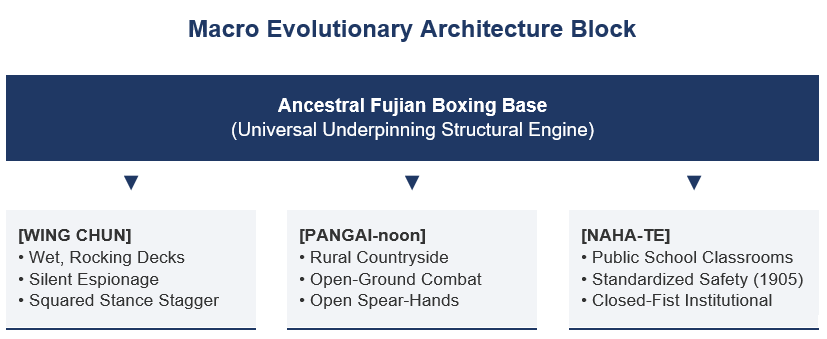
- The Wing Chun Trajectory: Faced with the wet, rocking wooden decks of Cantonese opera riverboats and the life-or-death stakes of anti-Qing espionage, the Red Junk rebels executed a radical structural compression. They squared the stance to anchor their gravity, muted their breathing for absolute silence, and abandoned theatrical animals to forge an unblinking, hyper-efficient machine built for close-quarters assassination.
- The Pangai-noon Trajectory: Operating in the rural Fujian countryside, Master Zhou Zihe and Kanbun Uechi preserved the raw code of the Tiger and Crane systems. They kept the stance asymmetric for open-ground advance, maintained the sharp, compressed nasal breathing required for sudden impact, and preserved the open spear-hands meant to tear flesh and pierce vital organs.
- The Naha-Te Trajectory: Moving on a completely independent track, Kanryo Higaonna’s heavy, closed-fist military boxing templates encountered a modern, institutional crisis in 1905. To transition from a hidden, dangerous trade into a standardized physical education program at the Naha Commercial High School, the art systematically closed its fists to protect school children from injury and simplified its tracking vectors for mass instruction.
The striking post-war visual alignment between modern Uechi-ryu and Goju-ryu was not an artifact of shared 19th-century masters, but a brilliant display of convergent evolution. Bound by the unyielding laws of human skeletal anatomy, separate masters independently discovered that there is only one mathematically optimal way to turn the body into an immovable shield. Decades later, Okinawan modernizers intentionally smoothed down the rough edges of Pangai-noon to match the dominant dojo etiquette of Goju-ryu, finalizing the visual illusion we see today.
Ultimately, the stories of Wing Chun, Pangai-noon, and Naha-te teach us that traditional martial systems are not fragile, static antiques to be worshipped blindly. They are living, breathing organisms. The Red Junk rebels, the rural Fujianese masters, and the Okinawan educational reformers did not preserve their arts out of sentimentality—they edited them, weaponized them, and restructured them to survive the world they lived in.
Recent Comments