Abstract
This paper challenges the commercialized “style creator” myths of 20th-century Okinawan Karate. By analyzing the structural, cosmetic, and tactical divergences between Tōon-Ryū (Naha-te), Uechi-Ryū (Pangainoon), and Gōjū-Ryū, this thesis demonstrates that these systems are living time capsules reflecting distinct chronological eras of Fujian White Crane Kung Fu. Furthermore, it highlights the intense cross-pollination within the Ryūkyū Tōde-jutsu Kenkyūkai (Okinawa Karate Research Club), establishing that Gōjū-Ryū was a crowdsourced, collaborative evolution heavily shaped by Kenwa Mabuni’s Judo/police metrics, Chōjun Miyagi’s Tegumi framework, and Go Kenki’s soft-style inputs.
I. The Historical Timeline Gap: 19th vs. 20th-Century White Crane
The structural, cosmetic, and philosophical differences between Uechi-Ryū, Tōon-Ryū, and Gōjū-Ryū exist primarily because they are living historical artifacts frozen at completely different points along the evolutionary timeline of Fujian White Crane transmission.
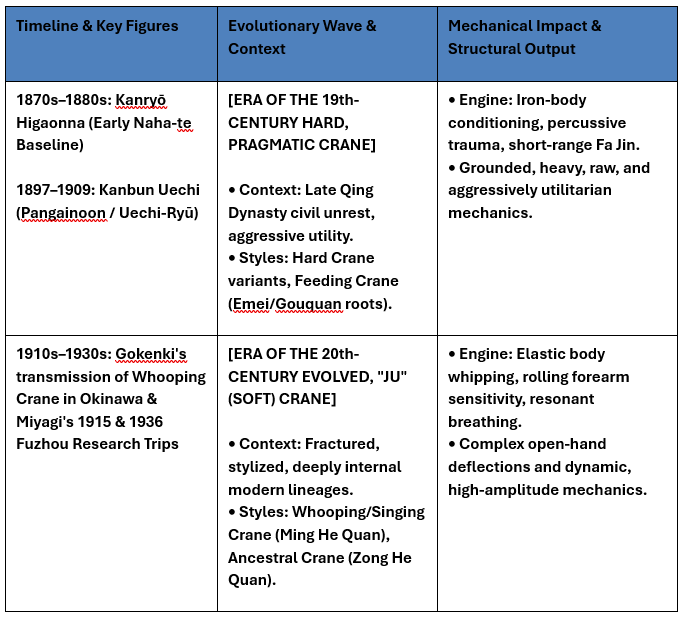
CHRONOLOGICAL WAVE OF FUJIAN WHITE CRANE TRANSMISSION
- The 19th-Century Time Capsule: Uechi-Ryū and Early Naha-te
Kanryō Higaonna trained in Fuzhou during the late 1800s, while Kanbun Uechi trained there from roughly 1897 to 1909 under Zhou Zihe (Shu Shi Wa). The Southern Chinese martial arts they encountered were highly pragmatic, explosive, and aggressively utilitarian.
This early era focused on structural conditioning, immediate percussive trauma, and short-range explosive power (Fa Jin). This is why Uechi-Ryū feels incredibly rigid, direct, and bone-smashing. Its Sanchin retains open hands, its breathing is sharp and explosive but unvoiced, and the primary weapons are raw, unpadded conditioned extremities like the toes and thumb-knuckles (Boshiken). It mimics a raw, less refined era of Chinese boxing. - The 20th-Century Time Capsule: Gōjū-Ryū and Shitō-Ryū
Chōjun Miyagi and Kenwa Mabuni did not directly experience Fuzhou in the 19th century. Instead, they were heavily influenced by later-era White Crane via the Chinese tea merchant Go Kenki, who lived and taught in Okinawa during the 1910s and 1920s, alongside Miyagi’s later research trips to China.By the early 20th century, Fujian White Crane had undergone a massive evolutionary shift in China, fracturing into highly stylized, smooth, and deeply internal lineages like Whooping/Singing Crane (Ming He Quan) and Ancestral Crane (Zong He Quan). These styles heavily prioritized elastic body whipping, complex soft-style open-hand deflections, rolling forearm sensitivity, and deep, resonant, diaphragmatic breathing models.
II. The Argument: Higaonna’s Percussive Engine
If we strip away modern organization names and look at the actual historical mechanics, the evidence strongly indicates that Higaonna’s original Naha-te template was fundamentally “Go” (hard) and percussive. The deep, flowing, structured “Ju” integration seen in modern Gōjū-Ryū was retroactively woven into the system after Higaonna passed away in 1915. This thesis is verified by comparing Gōjū-Ryū with its senior sister-style, Tōon-Ryū.
-
- Juhatsu Kyoda’s Preservation and the Sanchin Paradox
Juhatsu Kyoda (Miyagi’s senior co-disciple) preserved Higaonna’s Naha-te with strict fidelity in Tōon-Ryū. A closed-door demonstration of Tōon-Ryū’s versions of Sanchin, and Sanseiru reveals an immense visual contrast with Gōjū-Ryū:- Natural, Fluid Respiration: Unlike the explosive, guttural Ibuki breathing Miyagi formalized for Gōjū-Ryū, Tōon-Ryū utilizes a completely natural, smooth respiration style. The focus is entirely on internal kinetic chain alignment rather than dynamic external muscle tension or isometric lockdown.
- The “Go” Kinetic Engine: The power generation relies heavily on rapid body dropping, hip mechanics, and direct, sharp percussive lines. It is visibly more linear and blunt than the circular, sticky Muchimi flows Miyagi later developed.
- Juhatsu Kyoda’s Preservation and the Sanchin Paradox
The Sanchin kata itself highlights this evolution. Some sub-lineages note that Higaonna originally taught Sanchin with open hands, much like modern Uechi-Ryū. The closing of the fist in Sanchin was likely Higaonna’s own doing when he began transitioning karate out of secret, backyard private lessons during the Meiji Restoration.
Teaching teenagers lethal, open-hand spear-eye thrusts, throat-gouges, and delicate tendon rips was an enormous liability. Closing the fist transformed a dangerous, killing-intent art into a safer, structured, and modern tool for physical education. Kyoda favored this closed-fist variation, influencing how it spread, proving that tactical adaptations to core forms were actively happening to meet the socio-political requirements of the early 1900s.
III. The Crowdsourced Crucible: The Okinawa Karate Kenkyūkai
Because early 20th-century Okinawa functioned much more like a modern MMA gym or a research laboratory than a collection of isolated, rigid dogmas, Miyagi, Mabuni, and their peers were constantly trading notes, sparring, and borrowing concepts to patch holes in their respective lineages. The formalization of the Ryūkyū Tōde-jutsu Kenkyūkai (c. 1918–1920) served as the supreme collaborative catalyst for modern karate.
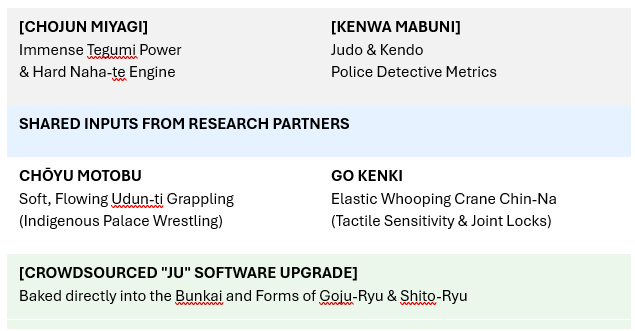
THE KENKYŪKAI LAB COLLABORATION
- Mabuni’s Grappling Blueprint and the Archivist Label
While Miyagi was a powerful wrestler adept at indigenous Okinawan Tegumi (or Muto), Mabuni had Judo and Kendo experience due to his training as a police detective. His real-world job required him to subdue and arrest suspects using soft compliance and restraint tactics without killing them.Mabuni was obsessed with Gyaku-waza (joint locking) and Nage-waza (throwing), as illustrated extensively in his 1934 book Kōbō Jizai Karate Kempō. Living, eating, and breathing martial arts research together during the 1920s, it is almost a certainty that Mabuni’s technical grappling insights heavily influenced Miyagi’s formulation of Gōjū-Ryū’s close-quarter defensive flow.It is believed that Mabuni himself famously stated, “There are no styles of karate, only varying interpretations of its principles.” This perfectly reflects that the hard organizational lines we draw today did not exist to them. If you compare the Naha-te katas shared between Gōjū-Ryū and Shitō-Ryū, they are virtually identical, containing the exact refinements Miyagi is thought to have made by himself. One could argue that the only reason Mabuni chose the name Shitō-Ryū was to act as a label for his vast historical archive. - Upgrading the Syllabus Software
Higaonna taught only three core forms: Sanchin, Seisan, and Sanseiru. Katas like Saifa, Seiyunchin, Shisochin, Seipai, Kururunfa, and Suparinpei were introduced later by Miyagi after his subsequent trips to Fuzhou, and were heavily reconstructed through the research group.When Miyagi wanted to inject closer-range grappling, sticky hands (Kakie), and throw-setups into his raw Naha-te template, he pressure-tested them against Mabuni’s structured Judo framework, Chōyu Motobu’s soft, flowing Udun-ti grappling, and Go Kenki’s White Crane Chin-Na.
IV. The Technical Smoking Guns: Seiunchin and Suparinpei
- Seiunchin as a Grappling SandboxThe kata Seiunchin is a perfect example of this collective engineering. While attributed to Miyagi, the influence of the Kenkyūkai is written across its entire blueprint. The heavy, non-stop reliance on Shikō-dachi (square stance), the total absence of kicks, and the explicit focus on sweeping blocks, arm-bars, and off-balancing techniques are completely native to a close-quarters grappling crucible. It is a form engineered for the exact Judo-leverage, Chin-Na, and Okinawan Tegumi that the group spent a decade breaking down.
- The Suparinpei AnachronismOfficial histories claim Suparinpei was passed from Higaonna to Miyagi, but historical protocol and biomechanics reveal a different story:
- The Transmission Gap: Higaonna never taught his senior student, Juhatsu Kyoda, Suparinpei. Kyoda remained in Okinawa while Miyagi left for military service; traditional protocol dictates that a master would never hide an ultimate form from their senior disciple while passing it to a junior. Instead, Kyoda’s Tōon-Ryū completely lacks the 108-step Suparinpei, while Kyoda explicitly went to Go Kenki to learn Nepai. This strongly implies Higaonna either never possessed Suparinpei, or the version we know today came from an entirely different source
- Flawless Symmetry: Gōjū-Ryū’s Suparinpei and Shitō-Ryū’s Suparinpei are near-perfect mirror images in their embusen (floor pattern), sequencing, and technical execution. Given Mabuni’s habit of altering forms to fit Shuri-te mechanics, this total lack of stylistic drift indicates that Miyagi and Mabuni learned it simultaneously from the exact same source, in the exact same room: from Go Kenki within the Kenkyūkai.
- Aerobic Mechanics: The structural, pragmatic Naha-te of Higaonna was grounded and heavy. The inclusion of a crescent kick, a 360-degree turn, and a jumping front kick in Suparinpei stands out like a sore thumb against Sanchin or Sanseiru. These athletic, high-amplitude elements are classic hallmarks of the later, more expressive 20th-century Whooping or Singing Crane brought over by Go Kenki.
V. Decoding the Geometry: Stances, Directionality, and File Compression
- Stances as Geometric Snapshots of Balance TransferTreating a stance as a literal, static posture to hold during a fight is the most common trap in modern karate. A stance is simply a geometric snapshot of dynamic weight distribution and balance transfer. The physical exaggeration within the kata is a visual and kinetic anchor—a teaching tool designed to over-exaggerate and amplify muscle memory of the center of gravity at any given millisecond.
- Neko-Ashi-Dachi (Cat Stance – 90/10 Bias): This represents a blueprint for instantaneous weight withdrawal and elastic recoil. By keeping 90% of the weight on the back leg, the front leg is entirely weight-free. Tactically, this allows the front leg to act as an immediate takedown lever, foot-hook, or a knee shield to prevent an opponent from recovering their balance.
- Shikō-Dachi / Kiba-Dachi (Straddle Stance – 50/50 Bias): This represents maximum downward kinetic rooting. In a grappling exchange, dropping your mass into Shikō-dachi lowers your center of gravity below your opponent’s hips. It freezes your base, ensuring you cannot be easily thrown or unbalanced.
- Sanchin-Dachi (Three Battles Stance – Compressed Pivot): The ultimate blueprint for spherical, close-quarters combat. Turning the toes inward and gripping the floor locks the pelvis to create a solid structural cylinder. When an opponent pushes, pulls, or strikes at arm’s length, this tight weight distribution allows the practitioner to micro-pivot their hips on a dime, deflecting incoming force while breaking the opponent’s structure and balance.
- The Directional Law of Kaisai-no-GenriBy utilizing Master Seikichi Toguchi’s rule of kata interpretation—where forward movements indicate offense and rearward movements indicate defense—we strip away modern sport-karate definitions and reveal the raw grappling countermeasures hidden in plain sight.
- Movements to the Rear (The Defensive Setup): When a kata instructs a backward step into a rear-weighted stance, you are actively withdrawing your hips and legs away from an oncoming assault or a single-leg shoot. By moving back, you force the attacker to over-extend and stretch out their posture.
- Therefore, a rearward Gedan Barai (Low Block) is not a block against a kick; it is an anti-takedown sprawl mechanic. Your driving forearm acts as a heavy cross-face or under-hip barrier across the back of the attacker’s neck or shoulder as your hips drop back. Concurrently, the chamber hand (Hikite) anchors and pulls up on their tricep or fabric. This lifts their shoulder while your blocking arm drives their head down—the exact leverage needed to kill a double-leg takedown and reinforce a sprawl.
- Movements Forward (The Offensive Smash): When a kata drives forward into a front-weighted stance, your mass is the weapon. You are capitalizing on cleared space to destroy their alignment.
- Therefore, a forward-moving Jodan Uke (High Block) as seen in Gekisai cannot be a passive block; smashing your forearm bone against an incoming fist requires immaculate timing and breaks down under adrenaline. Instead, it is an aggressive, close-range crashing shield or collar-tie. The upward-driving forearm acts as a structural wedge rammed directly under the attacker’s chin or throat as you crash into their space, breaking their neck posture and setting them up for a Mabuni-style Judo takedown.
- Mawashi Uke and the “Catalog” Theory of Kata
Kata was never meant to be a literal choreography of a fight; it was a file compression system. Because early martial artists lacked video cameras, they needed a way to pass down complex, abstract physical concepts without them getting lost over generations. If you teach a student 50 separate tricks for deflecting and clearing hands at different heights, they will forget 45 of them. But if you bake the underlying geometry of those 50 tricks into one continuous, rolling, wheeling motion (Mawashi Uke), the student retains the universal blueprint for all of those options.
THE MAWASHI UKE ENCYCLOPEDIA
The Dynamic Sphere of Protection
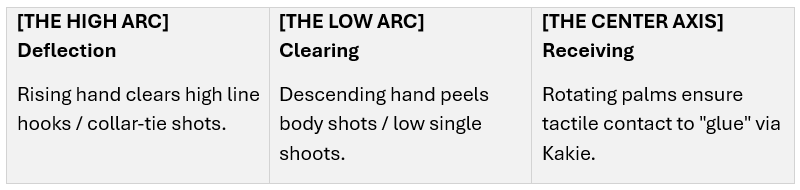
Mawashi Uke is not a literal technique to be pulled out of a toolbox during a fight; it is an abstract mnemonic device—an encyclopedia of kinetic options compressed into a single movement pattern. In a real-world, high-stress clinch, a practitioner will never throw a full, theatrical Mawashi Uke. Instead, they will use a micro-fraction of that circle—a 2-inch twitch of the wrist to clear a collar tie, or a subtle roll of the forearm to receive a punch. But they can execute that perfect micro-adjustment because they have deeply ingrained the macro-concept of the entire wheel.
The validity of this “encyclopedia of principles” theory is proven when observing how this exact tactical page is formatted across the sister styles:
- Uechi-Ryū (Wauke / Hirate Mawashi Uke): Kept the circle but kept it tight, flat, and alternating directly from their Sanchin guard. Stripped of all performance aesthetics, it serves as an active, rolling tactile sensor to catch an opponent’s arm, strip a grip, and clear a line for devastating Boshiken strikes.
- Tōon-Ryū (Minimalist Deflection): Because Kyoda bypassed Miyagi’s later stylizations, Tōon-Ryū assumes you already understand the geometry of the circle and excludes the macro-wheel entirely. It utilizes short, rapid Ura-uke (back-hand deflections) and immediate Te-nagashi (hand slips), executing only the exact micro-fraction of the circle needed to redirect a fist and counter instantly.
- Gōjū-Ryū and Shitō-Ryū (The Pedagogical Showcase): Miyagi and Mabuni expanded the movement into a beautifully clear, macro-level loop so that students could visualize and preserve the entire spherical boundary of their defense over generations.
VI. Conclusion: Same Engine, Tailored Outputs
The deep historical and mythological overlap between Fujian White Crane and Wing Chun offers the ultimate proof of this pedagogical framework. The oral legends of both systems are structurally identical: Fang Qi Niang synthesizes a close-quarters system in Yongchun county after watching a crane defend itself against a stick; a century later, the nun Ng Mui flees to the White Crane Temple, witnesses a crane fight a snake, and teaches a system to Yim Wing Chun. Historically, the oldest sub-branches of Wing Chun openly track their roots back to a system originally called Yongchun Baihe Quan (Yongchun White Crane Fist) before drifting linguistically into Cantonese. They are branches growing out of the exact same trunk.
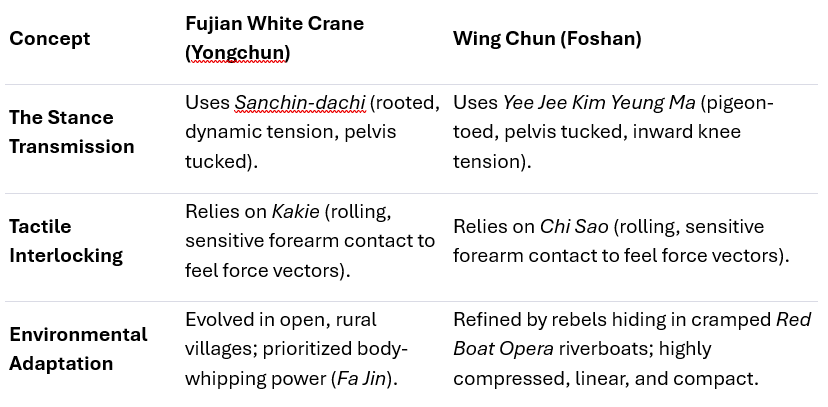
If the underlying physics, mechanical concepts, and historical origins are identical, why do they look so different? Because martial arts are not fixed, divine laws handed down on stone tablets—they are fluid, adaptive pedagogical frameworks designed to pass functional combat habits from one human body to another. The methods were intentionally modified to suit the individual, and the student finalized the style based on their own physical characteristics, athletic ability, and environment.
The Tragedy of Modern “Styles”
When a master teaches a student, they are giving them a set of blueprints. If the student is short and stocky, they will naturally prioritize the close-range, heavy-set attributes of that blueprint. If the student is tall and long-limbed, they will leverage linear, fast tracking.
The tragedy of modern martial arts commercialization is that generations later, the grand-disciples look at these personalized adaptations and say, “My master stood like this, so your master’s stance is wrong.” They treat a fluid teaching method as a rigid religious dogma rather than recognizing it as a personalized filter.
Mabuni’s quote echoes perfectly here: “There are no styles of karate, only varying interpretations of its principles.” Wing Chun, Quan Fa, Pangainoon, Tōon-Ryū, and Gōjū-Ryū are not separate, competing entities; they are merely different dialects of the exact same Southern Chinese short-bridge combat language.
Recent Comments